Care training5 min read
How often should staff refresh Basic Life Support training?
Resuscitation Council UK and Skills for Care both point to at least annual Basic Life Support updates. First aid certificates last three years.

The short answer
Refresh Basic Life Support (BLS) at least once a year. Resuscitation Council UK (RCUK) says healthcare staff should have "at least annual training and updates in CPR", and Skills for Care gives the same advice for adult social care in England. This annual standard comes from national guidance; no UK law sets a fixed deadline.
Formal first aid is different. The Health and Safety Executive (HSE) says workplace first aid certificates last three years.
These rules come from UK bodies. Employers elsewhere should check their national resuscitation council, but annual BLS updates are a sensible baseline anywhere.
On this page
How often should care and healthcare staff do BLS training?
At least once a year. RCUK's core standard says healthcare staff should receive at least annual CPR (cardiopulmonary resuscitation) training and updates, based on their role.
RCUK's standards for primary care and acute care say "clinical staff should have at least annual updates." In primary care, "non-clinical staff generally should have annual updates also." A local risk assessment can shape how often non-clinical staff refresh.
For adult social care, Skills for Care's December 2025 guide says formal BLS training is required "when identified or at least annually".

Is annual BLS training a legal requirement?
No law in the UK names a 12-month interval for BLS. The annual standard comes from RCUK and Skills for Care guidance.
The law sets the duty to train. In England, Regulation 18 of the CQC (Care Quality Commission) fundamental standards says staff must get the training they need for their role. Skills for Care links this duty to its training guide.
Following national guidance is the clearest way to show you meet that duty. If you depart from the annual standard, record your reasons in a risk assessment.
How is BLS different from first aid?
BLS covers recognising a cardiac arrest, calling for help, chest compressions and using a defibrillator (AED). First aid is wider. It covers injuries and sudden illness, such as bleeding, burns and choking.
Swipe the table sideways to see every column.
| Item | Basic Life Support | First aid at work |
|---|---|---|
| Main guidance | Resuscitation Council UK; Skills for Care (social care) | HSE |
| Refresh or renew | At least annually | Certificate lasts 3 years; requalify before it expires |
| Extra advice | Must include hands-on CPR practice for basic and enhanced courses | HSE strongly recommends annual refresher training |
| Who needs it | Care and healthcare staff, based on role | Named first-aiders, based on the first aid needs assessment |
HSE says that once a first aid certificate expires, the person is no longer considered competent to act as a workplace first-aider. They need a requalification course to get a new three-year certificate. HSE's FAQ confirms the annual first aid refresher is "strongly recommended", not mandatory.

Does BLS refresher training need a practical element?
Yes, for proper CPR courses. RCUK's community training standard says at least annual refresher training should be provided. For basic and enhanced levels, "this must include practical performance of CPR."
RCUK also accepts a range of methods for annual updates in healthcare settings. These include simulation, drills and e-learning.
A good model is online theory plus a short hands-on session and a competency check. Skills for Care says employers should check and record that staff are competent, not only that they attended.
Example: A home care agency has 40 staff. The registered manager sets BLS as an annual course. Each carer completes the online theory first, then a 30-minute practical session on a manikin with a supervisor.
The supervisor signs off each person's competency. The training matrix flags anyone due in the next 60 days.
Have the resuscitation guidelines changed recently?
Yes. RCUK published its Guidelines 2025 on 27 October 2025. It said updated courses and manuals would be available from January 2026.
RCUK asked organisations to start putting the changes in place over the following 12 months. If your staff last trained before 2026, check that their next refresher uses material based on the 2025 guidelines.
How do we keep track of BLS renewals?
Record each person's completion date and set the expiry at 12 months. Flag people a month or two before they are due.
A training matrix does this well. See how to build a training matrix for a care home or download our ready-made care home training matrix. For renewal periods across other topics, read how often care training needs renewing.
Estimate. You’re charged in pounds (GBP); your bank sets the final rate.
FAQs
How long is a Basic Life Support certificate valid?
Resuscitation Council UK and Skills for Care both recommend BLS updates at least once a year. So most employers treat BLS training as valid for 12 months. Some certificates may show a different date, but your employer's policy and national guidance decide when you refresh.
Do non-clinical staff need BLS every year?
RCUK's primary care standard says non-clinical staff "generally should have annual updates also", with a local risk assessment allowed to shape this. At minimum, non-clinical staff in healthcare settings should be able to recognise cardiac arrest, call for help and start chest compressions.
Is a first aid certificate valid for three years?
Yes. HSE says certificates for first aid at work last three years. First-aiders must requalify before the certificate expires. HSE also strongly recommends annual refresher training to keep skills fresh, but says this is not mandatory.
Can BLS refresher training be done online?
Online learning suits the theory. RCUK says basic and enhanced CPR refresher training must include practical performance of CPR, so add a hands-on session and a competency check. Skills for Care expects employers to check staff are competent, not only trained.
Next step
Start the free Basic Life Support course online. Pass with 70% or more and you can buy a £9.99 (est. US$13, an estimate. You are charged in pounds and your bank sets the final rate) certificate with a unique certificate number that anyone can check at /verify.
Basic Life Support courseSources
The official guidance this page is based on. Check the source for the latest rules.
- Resuscitation Council UK: Quality Standards, Introduction and overview (opens in a new tab)
- Resuscitation Council UK: Quality Standards, Primary care (opens in a new tab)
- Resuscitation Council UK: Quality Standards, Acute care (opens in a new tab)
- Resuscitation Council UK: Quality Standards, CPR and AED training in the community (opens in a new tab)
- Resuscitation Council UK: RCUK publishes Guidelines 2025 (opens in a new tab)
- Skills for Care: Statutory and mandatory training guide for adult social care employers (December 2025) (opens in a new tab)
- HSE: Are you a first-aider? (opens in a new tab)
- HSE: Frequently asked questions on first aid (opens in a new tab)
Related courses and pathways
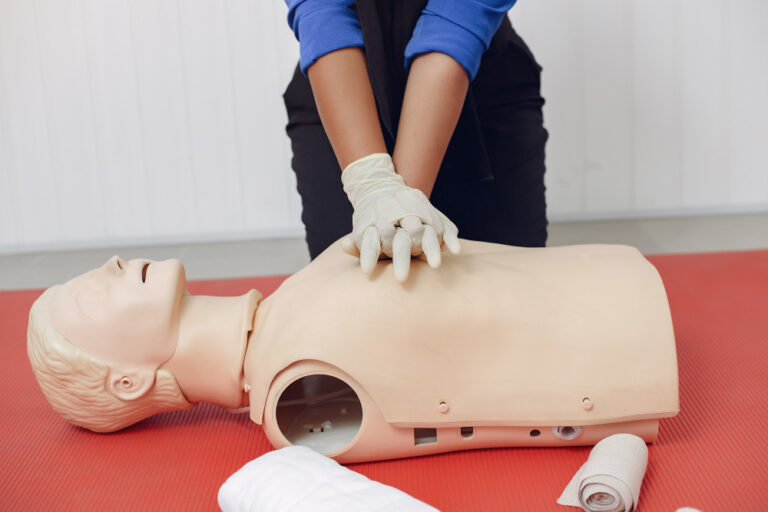 Course · HealthcareBasic Life SupportRespond to life-threatening emergencies with the core skills of basic life support.See the course: Basic Life Support
Course · HealthcareFirst Aid in CareWhat to do in the first minutes of an emergency in a care setting, from CPR to burns, choking and falls.See the course: First Aid in Care
 Course · HealthcareEmergency Response for Healthcare WorkersBasic life support using the DRSABC approach and the chain of survival.See the course: Emergency Response for Healthcare Workers
Keep reading
Care training6 min read
Funded and free training for care staff: what is available?
How the Learning and Development Support Scheme reimburses care employers in England, plus free e-learning options care staff anywhere can use.

Care training6 min read
How often does care training need renewing?
Most core care training is refreshed at least every 3 years, basic life support yearly. What is law, what is guidance, and what triggers an early refresh.

Care training6 min read
Is the Care Certificate mandatory?
No law names the Care Certificate, but CQC-registered employers in England must give new care staff an induction. Here is what that means for you.

PDF2 CSV
Free download
The care home training matrix spreadsheet
See at a glance who is in date, who is due soon and who is overdue, for every worker and every course.


