
MySkillsPlace

Clinical Skills for Nurses Level 1 (Approved by the Nursing and Midwifery Council of Nigeria)

Core clinical skills for nurses, approved by the NMCN for 3 CEU points towards your licence renewal.

  • 71 lessons
  • About 30 hours(estimate)
  • Professional
  • Online
  • No time limit

LPTC certificateCertified by London Professional Training Centre · £11.14 (est. US$15, an estimate. You are charged in pounds and your bank sets the final rate) when you passThe qualification certificate is issued separately by NMCN and LPTC.

Free to study

Estimate. You’re charged in pounds (GBP); your bank sets the final rate.

£11.14 (est. US$15, an estimate. You are charged in pounds and your bank sets the final rate) certificate when you pass

Create a free account (or log in), then start straight away. You can confirm your email later.

LPTC certificate. Certified by London Professional Training Centre · £11.14 (est. US$15, an estimate. You are charged in pounds and your bank sets the final rate) when you passThe qualification certificate is issued separately by NMCN and LPTC.

  • 71 lessons
  • A quiz after each module

Approval and CEU points

This course has been approved by the Nursing and Midwifery Council of Nigeria (NMCN) to award 3 CEU points. Nigerian nurses must renew their nursing licence every 3 years, and the CEU points from this course count towards that renewal.

What you’ll learn

Clinical Skills for Nurses Level 1 covers the core clinical skills nurses use every day: measuring and interpreting vital signs, recognising a patient whose condition is getting worse, infection prevention and control, wound care, safe medicines administration and injections, blood glucose checks, catheter care and fluid balance, Basic Life Support, safe moving and positioning, clear nursing documentation, and professional communication with patients and families. The course is approved by the Nursing and Midwifery Council of Nigeria (NMCN) and awards 3 CEU points towards your nursing licence renewal.

  • Measure, record and interpret vital signs accurately: temperature, pulse, respiration, blood pressure and oxygen saturation
  • Recognise a patient whose condition is getting worse and escalate care using early warning scores
  • Apply infection prevention and control, including hand hygiene, PPE and safe waste disposal
  • Use aseptic non-touch technique for wound assessment, dressing and care
  • Prepare and give medicines safely, following the "rights" of medication administration
  • Give intramuscular, subcutaneous and intradermal injections correctly
  • Check blood glucose and respond to hypoglycaemia and hyperglycaemia
  • Do basic urinary catheter care and monitor fluid balance
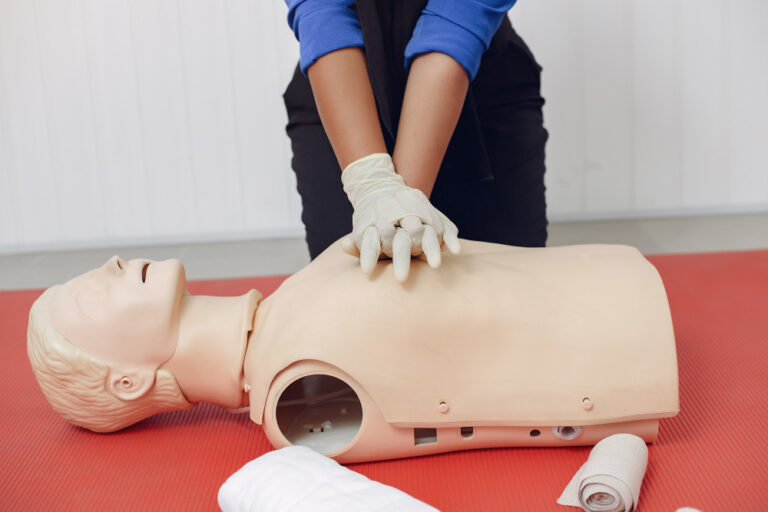
  • Carry out Basic Life Support (BLS) and respond to clinical emergencies
  • Move and position patients safely to prevent pressure ulcers and falls
  • Write clear, accurate nursing documentation that meets legal and professional standards
  • Communicate with patients and families with professionalism, empathy and respect for confidentiality

Who it’s for: Registered Nurses, registered Midwives, newly qualified nurses, internationally educated nurses, healthcare professionals in Nigeria planning to work overseas, nurses seeking career progression or leadership opportunities.

What’s inside

71 lessons, each with a short quiz.

  1. 01Introduction and Why BLS Matters
  2. 02Recognising an Emergency and Taking Action
  3. 03Airway, Breathing and CPR
Show all 71 lessons
  1. 04AEDs and Choking
  2. 05Legal and Ethical Responsibilities
  3. 06Health and Safety for Healthcare, module 1: Understanding Pain and Its Impact
  4. 07Health and Safety for Healthcare, module 2: Risk Assessment and Preventing Harm in Healthcare Settings
  5. 08Health and Safety for Healthcare, module 3: Infection Prevention, Hygiene and Healthcare Safety
  6. 09Health and Safety for Healthcare, module 4: Manual Handling, Patient Movement and Musculoskeletal Safety
  7. 10Health and Safety for Healthcare, module 5: Workplace Hazards, Hazardous Substances and PPE
  8. 11Health and Safety for Healthcare, module 6: Fire, Electrical Safety and Emergency Procedures
  9. 12Health and Safety for Healthcare, module 7: Incident Reporting, Accidents, Near Misses and Workplace Safety
  10. 13Health and Safety for Healthcare, module 8: Creating a Safe Healthcare Environment
  11. 14Foundations of Infection Prevention and Control
  12. 15Understanding Infection and Breaking the Chain
  13. 16Risk Assessment, Legal Controls and Workplace Management
  14. 17Standard Precautions, Hygiene and PPE
  15. 18Introduction and the Nurse’s Role in Physical Health Monitoring
  16. 19Vital Signs: Assessment, Normal Ranges and Clinical Significance
  17. 20Respiratory, Cardiovascular and Neurological Assessment
  18. 21Fluid Balance, Nutrition, Skin Integrity and the NEWS2 Tool
  19. 22Recognising Deterioration, Documentation and Case Studies
  20. 23Understanding Anaphylaxis
  21. 24Causes, Triggers and At-Risk Patients
  22. 25Recognising an Anaphylactic Reaction
  23. 26Emergency Response and First Aid
  24. 27Understanding Catheters and the Urinary System
  25. 28Risks, Complications and Infection Prevention
  26. 29Catheter Insertion and Aseptic Procedure
  27. 30Ongoing Catheter Care: Including Suprapubic Catheters
  28. 31Catheter Care
  29. 32Advanced Foundations of Safeguarding and Legal Frameworks
  30. 33Complex Abuse, Organisational Risk and Emerging Threats
  31. 34Leading Safeguarding Responses and Multi-Agency Practice
  32. 35Safeguarding Leadership, Culture and Managing Allegations
  33. 36The Foundations of Safe Moving and Handling
  34. 37Identifying and Managing Risk
  35. 38Person-Centred Safe Practice
  36. 39Moving and Handling Equipment
  37. 40Practical Handling Techniques
  38. 41The Care Planning Process: From Assessment to Action
  39. 42Concept Care Mapping and Implementing the Care Plan
  40. 43Medical Records, Legal Frameworks and UK Policy
  41. 44Confidentiality, Data Protection and Safeguarding
  42. 45The Nurse’s Role and the Legal Framework
  43. 46Understanding Medications: Doses, Prescribing and Routes
  44. 47Subcutaneous Injections and Parkinson’s Medication
  45. 48Numeracy Foundations: Decimals, Metrics and SI Units
  46. 49Calculating Doses for Solid Oral Medications
  47. 50Calculating Doses for Liquid Oral Medications
  48. 51Calculating Doses for Injections
  49. 52IV Infusions and Flow Rate Calculations
  50. 53Dosage Calculations by Body Weight
  51. 54Storage, Safe Disposal and Adverse Events
  52. 55Pain Management, module 1: Understanding Pain and Its Impact
  53. 56Pain Management, module 2: Recognising and Assessing Pain
  54. 57Pain Management, module 3: Pain Assessment and Person-Centred Care Planning
  55. 58Pain Management, module 4: Medication and Safe Pain Management
  56. 59Pain Management, module 5: Non-Medical and Holistic Pain Management
  57. 60Pain Management, module 6: Managing Chronic, Complex and Persistent Pain
  58. 61Pain Management, module 7: Pain Management at the End of Life
  59. 62Pain Management, module 8: Legal, Ethical and Professional Practice
  60. 63Introduction to Venepuncture, Principles, Anatomy and Professional Standards
  61. 64Equipment, Vein Selection and Infection Prevention
  62. 65Insertion Technique, Order of Draw and Procedure Closure
  63. 66Complications, Aftercare and Professional Reflection
  64. 67Understanding Verification and Expected Death
  65. 68When a Registered Nurse Can Verify an Expected Death
  66. 69The Verification Procedure
  67. 70Procedures Following Verification
  68. 71Case Studies

How this course works

Watch a short lesson, pass the quiz, and download a certificate with an ID any employer can check.

01 · Lessons

Short videos you can finish on a break

  • Module 1: Introduction and Why BLS Matters
  • Module 2: Recognising an Emergency and Taking Action
  • Module 3: Airway, Breathing and CPR

At a glance

lessons
71
Study time
~30 hrs
Level
Professional
Pass mark
70%

Study time is an estimate.

Free to study. £11.14 (est. US$15, an estimate. You are charged in pounds and your bank sets the final rate) certificate when you pass

02 · Quizzes

A short quiz ends each module

70% to pass. If you do not pass, review the lesson and try again.

03 · Certificate

The qualification certificate is issued separately by NMCN and LPTC.

Employers check it online

Questions, answered

Is this course free?

It is free to study. The certificate costs £11.14 (est. US$15, an estimate. You are charged in pounds and your bank sets the final rate), and you pay only if you pass and want to download it.

How long do I have to finish?

You study at your own pace. Your progress is saved after every lesson, so you can stop and pick up where you left off.

How am I assessed?

Each module ends with a short multiple-choice quiz. You need 70% to pass. If you do not pass, review the lesson and try again.

How do I get my certificate?

When you pass the final quiz, your certificate is ready to download from My learning. Each certificate has a unique certificate number that employers can check on our Verify page.

Learners often take next

All healthcare courses
  • Popular

    Basic Life Support

    Healthcare

    5 lessons~2 hrsIntroductory

    Free to study

    £9.99 (est. US$13, an estimate. You are charged in pounds and your bank sets the final rate) certificate when you pass

  • Popular

    Emergency Response for Healthcare Workers

    Healthcare

    7 lessons~3 hrsIntroductory

    Free to study

    £9.99 (est. US$13, an estimate. You are charged in pounds and your bank sets the final rate) certificate when you pass

  • Popular

    Care Certificate

    Healthcare

    17 modules~8 hrsInduction

    Free to study

    £9.99 (est. US$13, an estimate. You are charged in pounds and your bank sets the final rate) certificate when you pass